IN THE FIFTH STEP MAGNETIC ATTRACTIONS. CHAPTER XXI - THE TENSION TESTS
THE more interesting part of our study and
practice is now reached.
We have in the previous chapters taken two
steps; one series of exercises stopped the leakage of vitality that was
constantly taking place; the other series overcame and corrected the erratic
action of the nerves.
The pupil who has mastered both of these will
find himpossessed of normal self-control, which will be sufficient for the
work now to be undertaken, although it may also be the fact that he is further
advanced.
The following presentation of the system of
development may be interesting.
1.
A person who wastes the nerve-force of the body faster than it
accumulates, belongs to the class of people called
nervous.
2.
A person who uses his nerve-force no faster than it accumulates,
possesses normal self-control.
3.
A person who accumulates more nerve-force than ought to be used
in a healthy and well-constituted daily life,
is magnetic to a
certain degree.
4.
Electricity and its consequent magnetism lie dormant or latent in every
drop of blood and every particle of matter in the human body.
5.
A person who can develop this latent electricity to an unusual degree
possesses an irresistible power.
6.
Any person who has stopped the leakage of the vitalforce and has corrected
the erratic action of the nerves, will be able to develop electricity to
an unusual degree by the exercises of this and the following chapters.
If we will constantly keep in mind the fact
that we are filled with latent electricity, we shall better succeed in
the work immediately before us.
The principle of life cannot be explained, yet
it is a process constantly generating the magnetic power. The author has known
of many persons who have so mastered the exercises of this series of lessons
that they could easily feel the life principle at work within them. This has
proven the seat of life to be co-extensive with the brains and the organs
enclosed within the walls of the chest, the spinal column and the diaphragm.
Physiologists who analyze this agency will at once comprehend the deeper
questions of life.
FORTY-SIXTH GRAND PRINCIPLE Tense conditions
magnetize.
It is the central law of magnetism. In the
first place, it is necessary to understand what is meant by the word tense. The
dictionary very nearly expresses it when presenting the definition as not
lax. It is also called rigid, or possessing the power of firmness.
In this study the meaning of the word tense is this: The power or
condition that exists when any part of the body is passing from a state of
laxity to a state of rigidity.
It is the opposite of laxity.
It is not rigidity.
In a condition of laxity the muscles are
devitalized or devoid of life-expression. In a condition of rigidity the
muscles are set; the work is done; the end is attained. Nothing is going on at
the time except that the nerves are holding the muscles in place just as a man
might hold a stone or a wall. To make this matter clear several principles must
be presented at this place and discussed together.
FORTY-SEVENTH GRAND PRINCIPLE
Setting the muscles produces
muscular energy only.
We see illustrations of the various uses of the
muscles in the way calisthenics are performed in classes, as much in the high
schools as elsewhere. When the movements are languid, we call the muscles
devitalized or lax. You may try these and see what is meant: Stand; raise the
hands to the shoulders; shut up the fingers lightly, half clinching the fists.
Extend the arms slowly in the front, oblique front, lateral, andother directions, and back a few
times, keeping the motions as languid as possible, and in every sense lazy.
Then do them rapidly but lazily. You see it does not make much difference what
degree of speed you use, if the muscles are lax. In such manner are most of the
exercises, calisthenics andother movements performed
in schools and under the direction of teachers of physical culture, and the
time is more than wasted. Lax movements and lax conditions produce weariness.
Lax walking is the cause of exhaustion. Like begets like. It is not good logic
to suppose that a muscular action can originate of itself; if it can, why will
not an amputated arm act as well by itself as when it has life to move it? Or
why does an electric current cause a detached leg of a frog to move its
muscles?
There must be energy behind the motion, or it
will have no vitality, and the nearer we get to the condition of energy the
farther we go from the tendency to weariness and exhaustion. For this reason any lax
movement is a detriment to the
vitality of the body; it is plain to understand that it loses its own
stored-up force without having it replenished from thesource of supply. Therefore, lazy walking, or lax walking, to use
a more polite term, is wearying. Therefore, also, the lax manner in which gymnastics,
calisthenics and physical culture movements are performed destroys all their
value and even detracts from the condition of the body prior to their
employment. This is
why so many hundreds of thousands of persons fail to get benefit from the
most valuable of all means of health.
If the growth of the muscular strength is what
is sought, this end is to be attained under the present grand principle. It is
by setting the muscles that we make them strong. The attempt to hang by the
arms from a horizontal bar without setting the muscles will tear away tissue
that is necessary to health. Pulling in the same way is injurious. But just as
soon as the muscles are set the tissue is protected and vitality supplants
laxity. Any experienced person knows what we mean. The method by which strength
is attained is found in this law; yet nothing but muscular strength comes from
such practice. The
facts may be concisely stated as follows:
1.
Lax movements weary and exhaust.
2.
Set movements strengthen the muscles.
3.
The continual use of set movements leads to stiffness and awkwardness,
unless relieved by counter-movements. The farmer and common laborer never make
use of the counter-effects; their bodies lose their graceful shapes; they are
strong enough, but never graceful or magnetic. It is almost always possible to
find grace among skilled artisans, for they relieve the body of its set
condition by counter-effects. It is also generally possible to detect a
magnetic person by a single movement, and often by the attitude taken when in a
position of rest.
FORTY-EIGHTH GRAND PRINCIPLE
Magnetic tensing is the
transit from laxity to rigidity.
The tensing is not the laziness of
devitalization, nor is it the stiffness of rigidity. In other words, it is not
a condition of rest or of fixed strength, but a process of change. It is the
progressive increase of energy. The process is one that may he easily
understood. When nerves and muscles are lazy, they depend upon no supply of
power from the vital sources of the body. When they are set, they are held by a
fixed degree of energy, which is alive but not progressive.
When the
muscles
are taken from a lax condition to one of
strength,but not allowed to reach a limit or to become setthe
nerves are
kept in a progressive condition. This everchanging effort makes a continual
demand on the source of
suply, and
the creation of energy is the result of that demand. There can be no growth of vitality where there is no
occasion for its use.
Nature ordains that a demand shall be necessary to create a supply. The same law holds true
everywhere. The muscles will not
grow at all if they are not used.Being
used, they break down their tissue; the blood is excited toward this breakdown,
and it leaves its nutrition to repair the waste, a thing it would not do had
there been no effort, no breakdown, no waste.
The only process by which man is able to
generate electricity within his body is by tensing. This consists in many waysof using the body. We see the most noticeable examples of it in persons
who appear before audiences to speak, sing,act or
otherwise hold the interest. They are more readily
observed, more readily singled out, and we find their actions more generally
understood. A person
possessed of magnetism does not tense and set the body all at once, for, if he
were to do this, the influence would soon be gone.
We recall hundreds of cases of lost magnetism
owing to this mistake.
Here is a lawyer, young and inexperienced; he rises to address the jury on an issue of great importance;
he is full of his case; his
magnetism springs from eye and voice and bewilders his listeners in the opening
sentences; he does not begin easily and
increasing his energy gradually, as one of skill in the
magnetic art would be sure to do; he plunges into the case with pent-up power
blowing off all its steamon the
first words; he holds all hearers in thralldom; then, in five minutes, he feels
that it is all gone, and the interest
flags. His case is lost. He wearied the jury. He commenced like an
Alexander and ended like a tired child. When his magnetism was blown
off in the first few minutes all his zeal, his earnestness, his power had to
vent itself in force; hshouted and gestured vehemently; having allowed
his magnetism to escape, he wearied the jury.
Many and many a speaker has told us that this
has been a common experience. They did not know the cause or the process of the
loss, but they knew that they began with a magnetic charm and soon felt its
collapse; then how empty and hollow the voice sounded. Speakers who know
nothing of the technical laws of magnetism are obeying those laws on the
negative or the affirmative side; they are failing or succeeding by them. To
commence any effort with a full head of energy means a blow-off, and no
opportunity is afforded for generating the power, for there is no tensing.
All greatness is plain, simple, humble and
quiet in its introductory efforts. This allows opportunity for tensing, for
growth, for an increase. Whether a conversation, a transaction or a speech, it
is to be likened to movements of the arm, thus:
1.
When the lax arm and hand are passed forward and back as in
calisthenics, no energy is expressed, and this would represent the indifferent
speaker.
2.
When the fist is held tightly clinched in the movements, the physical
and noisy speaker is represented.
3.
When each motion of the arm begins languidly and energy is called in
gradually and increasingly instead of all at once, the magnetic speaker is
represented.
It is worth one's while to watch such a person,
whether speaker, actor or conversationalist. Let us look at the first named,
the speaker. He steps forward on the platform, calm and easy. The audience may
be regarded as strangers to him, or he to them. What will his effort prove him
to be? We cannot tell as yet, for we know nothing of him by reputation or
experience; but the student of magnetism may detect in his repose and coolness
the evidence of a magnetic power yet to show itself. This, however, may be born
of stupidity and cheap conceit. A few minutes of time will tell; for, if he is
of the latter mold, the moment he attempts to warm up he will evince
nervousness, and he will warm up suddenly.
He proceeds as easily as he began, but he has not displayed any evidence of the
great orator. To be sure hspeaks fluently
and steadily, if somewhat slowly. His languageis interesting; it shows thought,
care in preparation
anda belief in its declarations. The audience listens well.
Theyreally know that it is not above the average quiet efforts
of oratory, but
it seems smoother and pleasanter. They like
it. They feel
that it is going to be more interesting; that
something greater is at hand. The very atmosphere seems
to contain that
information. The man
does not rear, or leap,
or plunge; he
makes no strides, no bursts of speed, zeal or
power. It is as
though his faculties were horses of fine mettle,
capable of all that could be desired, yet checked in and
trotting along at an easy jog.
Soon the interest deepens. It appears to be in the facts presented, but the
voice and manner present them so pleasingly that the audience would rather
hear them than read them.
Now the student of magnetism notices that the eyes of the speaker have darkened; no one else
pays any attention to the
tiny fact. The gray or
brown or blue or hazel has not changed, but the pupil has distended, and this
always appears
black.Then the student of magnetism, sitting on the platform or in the front row, has observed that
the body of this speaker, untrained in the art as he probably is, has changed;
the chest is
gradually, very slowly indeed, solidifying; it is full, large and firm, but
motionless; the arms no longer hang
devitalized, nor have they suddenly become rigid. The shifting from the
easy repose of the opening lines to the energy thatfollows has been imperceptible to
everybody except the keenest observer. The speaker is not only holding his
magnetism, he is collecting more, generating it rapidly by slow
tensing; and soon it is felt upon the waves of his voice. Every ear is
attentive.
Little by little, unconsciously
to the audience,
the speaker has increased the tension of every partof his body and of every
faculty. He himself
may have
no knowledge of
it, for he may not think of it, but the fact
exists in him as in all magnetic persons, that there can be no
increase of power unless it is accompanied by a
corresponding increase of tensing. How was this fact ever seized upon for
exercises in this art? Simply because it was universally noticed that all men
and women who were possessed of personal magnetism were always in a tensed
condition while cool and under perfect control. They were not devitalized, lax,
flabby, on the one hand, nor were they set and physical on the other. They kept
themselves in a condition between the two extremes. When the speaker is getting
control of his audience he is very quietly tensing his body. It is a gentle
change, but nevertheless a powerful one in its effects.
FORTY-NINTH GRAND PRINCIPLE
Tensing is a vibratory
condition that acts upon the ether.
By the present use of the word we refer to that
quiet form of increase in the development of energy that never reaches its
limit of power. It is gentle, but not lax. It is firm, but not set. Between the
extremes there is opportunity for a long range of increase without too great
firmness. If we can make this clear we shall be able to get you started right
in the present period; and that will mean much to you.
We have met students who have failed, and we
can always tell in advance why they have failed. A gentleman called upon the
author some years ago and said, "I have not made as much progress in the
development of magnetism as I ought, although some of my friends have done
remarkably well." We replied, "It is possible to write down the cause
of your failure before you explain anything in detail," and we wrote and
sealed a brief statement which we gave him. Then we asked him to perform the
tension movement a half-dozen times. This he did. We said, "The cause of
your failure is in that envelope. Open it." He did so, and read, "You
tense too suddenly and reach the limit of force. Both these faults or either of
them, will stop all progress."
The
ideas seemes new
to him. Then came the natural inquiry, What is the book intended for?
Careless persons rarely ever grasp the essential idea of anything, In
this line of practice the first thought is to make the arms and body tremble.
It may not always occur that this can be avoided, especially under the strain
of great intensity of feeling; but the vibrations of a trembling body are as
large compared with those of magnetic waves as the billows of the ocean are
greater than the pulsations of light. Nothing can vibrate the ether, or inner
air, except light and magnetism, and the latter is the finer. This means a
great deal when one understands the fine character of light-waves.
All movable masses are made for vibrations. The ocean sends out its
rhythmic motion as a medium for the transportation of matter. The air is a
gaseous ocean intended to vibrate in sound. Where there is no air there is no
sound. The higher up we go the less dense is the air and the less energetic is
the tone, until, amid the attenuated sky, it vanishes into space, and then all
is ether. Between the beings of the earth the atmosphere is the connecting sea,
the medium of sound and speech. We hear because the air vibrates upon the drum
of the ear, and this wave-process travels over the nerves into the brain,
beating there against the sensitive gray matter which converts it into meaning.
It is not possible anywhere in the universe for an influence or a
communication to span a chasm of nothingness. In space, where there is no
atmosphere, man could not talk to his fellow-being, if sound were to be the
means of speech. Yet one kind of wave-communication would give way to another.
Light shines everywhere, in the dead calms of space as well as in other
conditions; for light employs the thinner sea of ether. The brain amid the
excitement of earthly existence requires the bold force of sound as a means of
bringing it information; but if it were free from this racket
its super-sensitive
nature would hear and interpret the vibrations of the inner air or ether, with
equal ease and greater certainty.
This ether is everywhere. There is no solid so
dense that the fine inner air does not bathe each and every one of its
molecules; they float and roll in it as the planets roll in the sky. This ether
is not only in solids, but it is omnipresent in air, earth, water, flesh,
blood and brain. There is not a thought, feeling or
pulsation of your mind that is not a generator of ether-waves, nearly all of
which die in the room around you, for they lack force. This ether connects your
mind and your soul with the mind and soul of every human being, just as the
atmosphere connects your bodies and voices. As you cannot reach all or even
many by what you speak, so you cannot influence many by what you feel or will,
all because you lack the energy required to effect control.
A tense condition of any faculty supplies this
energy, but it must have the power of magnetism back of it, just as a live
electric wire must have a battery or generator to supply its force. It could be
alive and yet weak. Tensing calls into action the magnetic stores of the body,
even increases them, and co-operates with the dead-still processes in producing
both quantity and power.
FIFTIETH GRAND PRINCIPLE The magnetic touch
is always tense.
The first test of a person of magnetism is in
the hand. If it is cold there is either a withdrawal of vitality for the time
being, or the individual is lacking in magnetism. Warmth alone is not
sufficient. It is necessary, but not all that is required. When you clasp the
hand of one who possesses this quality, the effect is not marked in any way
except by a slight muscular interest. The tight grasp is set and valueless,
while the lax touch is dead. No one likes to take a cold and flabby hand.
There are men and even women who delight in
hurting the hand by giving a tight squeeze every
time they welcome
an acquaintance.This physical, and not in good taste. To set the
muscles for vigorous pressure is just as
far from
magnetism as is the lax hand which weak persons adopt from
necessity.
Marital
affection is the quickest
generator of
magnetism, in a temporary way, that is known, as is fully explained in the new
volume, "Sex Magnetism," which is one of the companion volumes to this book. Even the ancients, fourthousand
years ago and less, knew that warm lips and warm hands were two of the
evidences of love.
Nature ordains this to be so, for she compels the two sexes to attract
each other, and gives them the power to win, to enchain, to enthrall, in order
that the race may be perpetuated. Yet in
many cases this is a blind magnetism. The loveless hearts,
or those that
never felt the power, are non-magnetic.
The delights of friendship are generally thrown away by
impetuous or careless individuals. What is the use of graspingthe hands
as if they were tools of ice, or setting them as
in a vice? Neither gives
pleasure. One is
affectation or
weakness; the other is physical and emotionless. The true
lover never hurts the hand of his sweetheart; the latter never
gives the light grip.
While timidity may vibrate the hand
and make it tremble, there is a series of inner, finer waves of
pulsation that are in no way related to the former, just as the
ocean may roll and toss in a storm, while its billows transmit
the vibrations of sound and the still tinier pulsations of light,
all at the same time.
The feelings in a human body are variously expressed, but the
magnetism of love always tenses the
body and proves itself in touch, voice and sight.
If in your own life or in the experience of others you wish
to know the
truth, and separate the real from the sham, apply
thisrule, and watch the results. When the hands clasp each
other weakly, there is a negation of the avowals that have
been uttered by the tongue or pen; when they are set in their
clasp, there is the affirmative evidence of pretence, the attempt
to seem in
earnest. If
love—genuine, honest love—prompts
thegreeting, the touch is at first as light, but soon holds the
hand in a slowly increasing pressure that never clasps tightly.
The interchange of opposite
magnetic currents is the most delightful sensation in the world. It is because of this great
law of human life that the book of "Sex
Magnetism" has been written. It has done, and is doing to-day, more good
than any other work or school of special education, for which reason it should
be placed within reach of all persons without cost but under proper conditions.
As we write there is an old couple, as they
call themselves, although the man is not sixty and the woman not much over
forty, sitting in a room across the way watching the November fires die in the
western sky. They hold each other's hand as sweetly as the tenderest lover of
nineteen; none too old to evince the keenest interest without impetuous
display. Look at the maiden and her fiance; they meet and greet with a
handshake that is perfunctory because they may not be altogether alone. But
when time and place are theirs they yield to each other a far different
tribute; it may be the good-by of the evening, or the more prolonged farewell
of the visit. Their eyes meet with deeper glance, moist with fervor; large,
full eyes charged with the expression of kindred emotions. They know
instinctively that the lips are the agents of speech, that words are idle vows,
but that the tokens of speech coming from the very source itself are deeds of
exchange that may be impressed with the seal of approval; and, in a delicacy of
approach that drifts like a golden vapor nestling against the silvery moon, he
bends over the uplifted face, while a pressure of the arm obliterates their
identity, and the crimson bloom mounts her fair cheeks and paints roses in a
garden of lilies. The cold-lipped reader of this page will shudder at our
description and think it strange. Without magnetism there is no sentiment in
life, no poetry, no sweetness, no charm, nothing but the plainness of
mechanical existence.
There is no better way of developing the power
of magnetism than in the touch of the hand through the ordinary greeting.
Avoid the two extremes. Remember that the lax hand is worthless, and that the
set grasp is insincere, if not an automatic fault. Do not think that mere firmness is all that is
required. Tensing is
an increasing approach to a rigidity
that is never reached when the
increase cannot be maintained, a limit is found and that is non-magnetic.
Nothing better indicates progress than this power, and progress never stands
still. It is in the first delicate growth toward firmness that the body, the
arm and the hand evince magnetism. Experiments can be made all day long with
decided results. It is hardly necessary to add that nothing unusual in your
conduct should attract attention, for it would at once end the usefulness of
the practice.
FIFTY-FIRST GRAND PRINCIPLE The magnetic
voice is always tense.
Magnetism, exerted through the voice in
speaking and singing, is so very important an accomplishment, that we devote
one entire Step in this course to the subject. Here, we briefly sketch some
phases of the use of magnetic voice.
There are three general classes of voices: the
flat, the tense and the emotional. The first is the common sound which is
everywhere heard, from the simplest remark up to the vigorous tones of the
huckster or the wearisome orator; a mere mechanism of sound. Flat voices are
never tense, never vibrant, never possessed of feeling; for which reason the
street vender would never succeed in the lecture field; and for which reason
also the vast majority of public speakers, preachers, advocates and others fail
who might be greatif they had the
enterprise to get better delivery.
In daily conversation this flatness of sound is
the universal experience. When a voice tires you, the cause is easily
ascertained. No tense voice is ever wearisome. Some vibrant voices are. Some
emotional voices are. There are so many characteristic classes of sound
vibration involved that the subject seems endless. Sound itself is a
wave-force, but when kept within its own range it is always sound. It is
possible to add other vibrations to it. Even the church organ is given a tremolo
that corresponds to the same action of the
singing and speaking voice; but this is neither
evidence of tenseness nor of feeling.
Many persons wonder why the piano or the organ
yields a more impressive sound under the touch of a genius than when the
amateur manipulates it; and why at times the expert is more skillful than
usual. Technique and finish are factors of importance, but there is the
indescribable something that cannot be accounted for by any rules of execution.
It is magnetism. But how can magnetism affect a musical instrument ? Is the
latter not a mechanical affair that is what it is made to be, a mere tool? Yes,
but so are the vocal cords of the throat. So is everything; bones, flesh, muscles,
nerves, all are parts of a machine of matter. Back of the material is the soul,
the vital-spark, the magnetic quality. So when the gifted musician touches the
keys of the musical instrument this quality lives in the vibrations of a tense
hand, waves as small as light-pulsations that go out into the air and awaken a
harmony in all other life.
If your voice is flat it can never be magnetic;
and the first step to be taken is towards the destruction of the flatness. This
is done by the adoption of the tremolo in all degrees of coarseness and
fineness; an old attempt to substitute the appearance for the reality. The
throat tremolo is used much in musical training, but it is not natural. Emotion
springs from the diaphragm, a large muscle situated at the base of the lung
cavity and just above the stomach. To find this muscle place the fingers over
the stomach at that place where the apex of the rib-arch is found. It is at the
highest part of the abdomen and the lowest part of the chest, at the soft bone.
When you cough the diaphragm jumps up and its
edge gives a leap forward. This can be detected by the fingers. Now take a deep
breath, place the palm of the left hand on this edge of the diaphragm and the
palm of the right hand over back of the left hand. Pronounce the sound
"oo" as long as possible, while shaking the lower chest with the
rapid action of thehands. This will make the tone shaky. It
is the only natural tremolo, for the diaphragm by its vibrations produces laughter, gladness, joy, grief, sorrow, weeping, crying,
hysterics and every mood known to the human heart.
This class of vibrations is divisible into a hundred or more grades. The
usual series in the study of expression embraces ten only and they should be
fixed in the voice by practice. After the hand has caused the tremolo the next
step is to produce it without the aid of the hand. Prolong the sound
"oh" instead of "oo," with a decided tremolo, and keep at
it until it is very easy to say such sentences as the following with ease:
"Pity the sorrows of a poor old man," "Oh, the long and dreary
winter;" "Dear master, I can go no further," and the like. When
this can be done the next step is to increase and decrease the range of the
vibrations; that is, to make them wider and narrower at will. The doing of this
is of the utmost importance, and is not an easy task.
We recommend that you make a gamut of the tremolos, from one to ten.
Take a large piece of brown paper and a heavy pencil. Across the top make a
wavy line, about ten inches long and two inches wide, and mark this the tenth
degree of the tremolo. Under it make another wavy line ten inches long, but
with waves only an inch high, calling it the ninth degree; under that put
another wavy line, three-fourths of an inch high, as the eighth degree; then
under that put the seventh degree, which will have waves a half inch high; then
the sixth degree, with waves three-eighths of an inch high; then the fifth
degree with waves one-fourth of an inch high; then the fourth degree with waves
one-eighth of an inch high ; the third degree with waves one-sixteenth of an
inch high; the second degree, with waves one-thirty-second of an inch high, and
a straight line for the first degree, representing a flat voice. The rule of
practice is to begin at the middle degree and increase then decrease in turn.
It will be seen that the scale of increase is not regular. When the finer
tremolos can be used at will it is necessary to exclude the plain ones. A plain
tremolo is one that is audible; it expresses emotion rather than magnetism. A
concealed tremolo is one that is present but not noticeable. It attracts no
attention as a
wave-action of sound, but it affords an easy
transit to a tense voice. To develop the latter we advise the foregoing practice,
and then the use of the sentences given in connection with the tense eye under
the following methods.
FIFTY-SECOND GRAND PRINCIPLE The magnetic
eye is always tense.
There is here another opportunity for a volume
on a single subject. The eye sees and is seen. The sense it embodies is the
most important of all. A deaf person can compel the eye to perform some of the
functions of hearing, just as a blind person uses the sense of touch with
greater delicacy and power. When a person speaks to another the latter gets
some of the meaning from the eye. It is not only natural but common to look
into the eye to see the individual. All persons in an audience look at the
speaker's eye whenever he interests them; in dull moments only they are
attracted to some other part of the body, some peculiarity, or some matter
that distracts attention.
The magnetic person generally holds attention
by the power of the eye when there is a direct effort made toward one or more
others; but the latter will have no consciousness of such influence. The
tensing of the eye comes out of the same power as the touch or voice when
either is magnetic. All energy is vibrant. The muscles are controlled by waves
of force; sound is likewise propelled; so is light; so is thought; and
magnetism moves by a similar law. Each has its origin, its source of supply,
and its method of transfer; and, above all, each has its kind of pulsation. We
never mistake light for sound. When science shall have laid bare the secrets of
life it will be known what the difference is between all these energies.
The use of the tense eye changes every part of
the face by somestrangelaw of our natures. It also invites a glow
into the eye itself that even the photograph
will record. This special brightness is due to the electrical energy which is
aroused by the tensed condition. This does not
arise in the eye-ball, but has its origin in the brain, which is the most
powerful electric battery of its size in existence; so that the tensing of the
latter organ is the real cause of it. We have For years used a plan of shifting
locations which we find to be the best method of tensing the brain and eye. We
present this arrangement here in a different light from any elsewhere given. We
take the nine locations of the eyes from a former plan, as follows:
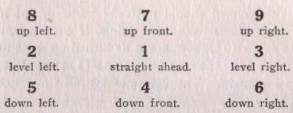
The first practice is to look (1) at some
imaginary person whose eyes are directly in front of you and on a level with
your eyes, adopting a dead-still body all through, but holding the eyes two
seconds only in a fixed gaze.
From one (1) change to two (2), which means to
move the gaze to the left lateral, but do not wink or move a muscle of the
face. Hold the gaze at two (2) for the same space of lime, two seconds.
Then come back to one (1) and hold the gaze for
two seconds.
From one (1) change to three (3), and hold the
gaze dead-still for two seconds.
Come back to one (1) for two seconds.
From one (1) change to four (4). Then back to one
From one (1) change to five (5). Then back to
one (I).
From one (1) change to six (6). Then back to one (1). From
one (1) change to seven (7).
Then back to one
From one(1) change to eight (8). Then back to one
(1).
From one (1) change to nine (9). Then back to one
(1).
Each position must be held two seconds.
In shifting the gaze, do it suddenly and by a
blow, so as to excite the nerves of the eye-balls.
Always shift to the extremes and back to one
(1), and never pass from any extreme to another without first coming to centre
each time.
The movement should not only be hard, but it
should be carried as far as possible. Thus, if the eyes are to be raised to
seven (7), they should be turned up so as to see the ceiling of the room; then
come to one (1) ; then to whatever extreme is sought. The extremes are all the
numbers except one (1).
After perfecting the foregoing movements let
the eyes pass from eight (8) to six (6) ; and from six (6) to eight (8) ; and
repeat ten times. Then from five (5) to nine (9) and reverse; then from two (2)
to three (3) and reverse; then from four (4) to seven (7) and reverse; each ten
times, hard, full and tense.
After all the foregoing movements have been
mastered so that the eyes may be moved to extremes with force, let the same be
repeated with great rapidity while the body is dead-still. This will prepare you for
the real work, which is called
THE REPETITIONAL
While holding the eyes in the positions
indicated by the numbers, repeat the following remarks with their full meaning
stamped in your tones:
When the eyes are at one (1) repeat: "I
am talking to you and you must hear me." Let the voice be low, clear
and firm, even severe.
When the eyes are at two (2) repeat: "You
cannot escape me." The
words should be spoken in deep tones as though
some
person were planning
to get beyond your influence. Remember that the face is to remain to the front
and no part must move except the eyes themselves.
When the eyes are at three (3) repeat: "Beware!
Do not make me angry."
When the eyes are at four (4) repeat: "I
will not do wrong."
When the eyes are at five (5) repeat: "Get
thee behind me, Satan."
When the eyes are at six (6) repeat: "I
am stronger than my enemies."
When the eyes are at seven (7) repeat: "Thou
God seest me."
When the eyes are at eight (8) repeat: "Right
is mighty and will prevail."
When the eyes are at nine (9) repeat: "Angels
hold watch and ward over my life."
The first few repetitions may be mental,
continuing them until the spirit of the sentiments in connection with the positions
shall be absorbed, after which it is better to use the voice aloud. Get familiar
with the locations as belonging to the sentiments uttered.
In repeating them aloud, speak the sentiment
once; then come back to the central position one (1).
After five days' practice in the Repetitional,
repeat each sentiment five times aloud while holding the eyes fixed in whatever
position they take, and go through them all.
After five more days in the last-named
practice, repeat each sentiment ten times in the position to which it belongs.
The success in tensing the eyes will depend
upon the tone-color in your voice. An actor could easily accomplish this end at
once. You may have to keep at it for weeks, but the power will come sooner or
later, and, once come, it always remains.
GENERAL TENSING EXERCISES
In the following exercises the mental conception
will be correct if the pupil thinks of the inner lower chest as the
centre of a powerful battery, from which a vast
amount of electrical energy may be developed. The connection of the brain with
this battery will be referred to hereafter as the electrical centre.
Action of some kind develops all the
electricity of the universe; we may call it friction, or chemical, or
chemico-frictional, as one scientist puts it—it matters but little. Some kind
of action is necessary. While the life principle within us furnishes a kind of
action that generates this force, it does not, in most cases, develop a
sufficient amount to make a person as magnetic as can be done by assisting
nature.
When, after some lapse of time, the pupil
begins to recognize the existence of the life principle, to estimate the amount
of electrical energy on hand, to know at what times, and why, the quantity gets
low, or at what times, and why, it is in superabundance, he will begin to
realize the exactness of the science of Personal Magnetism, and his interest
will be thoroughly aroused, for the first time, perhaps, in this course of
study.
Exercise I. The Tense Arm Straight. Raise the right arm in front on a level with the
shoulder and keep it perfectly straight. By an act of the will tense all the
muscles from the shoulder to the hand, including the fingers, without moving
the arm. Repeat this slowly and deliberately six times. Then use the left arm
in the same way. While the left arm is being so used the right should hang at
the side lifeless, and likewise the left when the right is in use. Returning
to the right arm, place it at full length at the right of the body, extended in
a horizontal position. Slowly and deliberately tense all the muscles six times,
without moving the arm. Use the left in turn. Repeat the exercises until each
arm has been placed in at least twenty different positions, keeping it always
straight. The positions may be made in a greater number than twenty if
desirable. Never set the muscles, nor use much force. Read all that precedes in
this Period.
Practice the Tense Arm as often and as
long as you wish
eachday. It can be
done without taking time, as in walking, driving, and on almost every
occasion. It is very
beneficial to the health.
Exercise II. The Tense Fist. This requires the open hand with lax muscles as a
beginning, and the very gradual increase of pressure as the fingers are closed.
Never set the fist hard, and avoid all rigidity. Sometimes the very powerful
clinching of the fist will arouse a muscular heat that is afterward useful in
true tensing.
Exercise III. Separating the Nervous Action. This is done by the act of the will, and
consists in tensing the arm while the fist is lax, and tensing the fist while
the arm is lax.
The separation of the nervous action may seem
difficult, but in a short time, by persistent practice, it can be
accomplished, and, when mastered, the opposition to the flow of nerve-force in
its accustomed paths will cause the same friction that develops lightning in
the storm clouds.
Are we understood?
When the arm is tense and the hand is free, the
flow of nervous force is stopped at the wrist and hurled back upon the centres.
A soldier whose hand has been amputated at the wrist often feels the presence
of the hand with as much realism as when it was in place. This indicates a flow
of nervous force beyond the wrist, and such experiences produce great weakness
to the person, sometimes causing an overflow of all the nerve-force, and
ending in death.
Many persons whose arms or legs have been
amputated lose their lives because the nerve-force flows away at these places.
Whoever can learn in a perfect way to stop the
nerve-force at the wrist, keeping the arm very tense and the hand free, will
recognize in time the flow of the life principle along the arms.
The last part of this exercise consists of
moving the arms about in space, held with powerful tensity from the shoulders
to the wrists, while the hands are lifeless or free from tension.
These exercises will grow better and better as
long as the
pupil practices them, if it be for years. At
first there will appear to be nothing in them. A child cannot learn to walk in
a day or a month.
Exercise IV. Union Tension of Arm and Fist. Hold the arm in any position free from the
body. Make it as limber as possible, without any muscular rigidity whatever.
Try to imagine it lifeless and limp as a piece of cloth. While in this
position, very gradually and very slowly cause it to pass from a limp to a
rigid muscular tension, while the energy flows from the fingers to the
shoulders. If this is not done gradually, the design of the exercise is
lost. A quick setting of the muscular strength of any part of the body has but
little benefit for the nerves. Do this over and over again, with each
arm singly. The first few days it would be better to use the muscles sparingly,
as lameness ensues from this as well as from any new exercise. This tension
includes arm and fist together.
Exercise V. The Tense Neck. There are muscles between the head and trunk of the
body, along the neck. They are intimately associated with the base of the brain
(an important part of the nerve-force of the body), and they likewise
lie close to the spinal column.
1.
Turn the head to the right as far as possible, and, while holding it there,
gradually increase the tension of the muscles, until they have been made firm,
but not rigid.
2.
Turn the head to the left and repeat in the same way.
3.
While looking straight ahead, the chin being on a level, and the chest
being well filled with air, the shoulders down, but not back, endeavor to throw
the muscles of the neck into a tension, commencing very gradually and increasing
slowly until great firmness is reached, but no rigidity.
A quick setting of the full muscular strength
is to be avoided, as the only benefit derived therefrom is in the growth of the
muscles. A slowly increasing tension keeps the nerves at work, and excites them
to an action that in time will generate the latent electricity of the body.
FIFTY-THIRD GRAND PRINCIPLE
The tense chest generates
vital-magnetism.
To the man or woman who would become magnetic
in the shortest possible time this principle is most important, for it is most
helpful. It is not enough that the vital organs be raised and maintained; that
is of the inestimable value, but the life itself of the chest and all its
contents must be kept energized. This does not mean that the chest is to be set
or strained by muscular effort, for that will lead to no good.
Direct the mind as closely as possible to the inner
portion of the chest, keeping the outward part immovable. Think of a point
as near the centre as possible. Make the whole internal portions tense, and as
gradually as possible. It will be some time before this can be accomplished.
The nerves and not the muscles are, in fact, exercised by this process.
A magnetic person can in an instant generate,
also, a heat within that can be felt very distinctly, giving a glow of warmth
that is transmitted by the vibratory process through the eye, voice or touch to
any person within reach of these.
Explanation.—The mind
dwelling intently upon any invisible agent or process within the body will
develop a mental recognition of what would otherwise be unrecognized, provided the mental conception of the agent
or process is a correct one. The tensing of the muscles and nerves must be
performed with some degree of care and thoughtfulness. The underlying reason
is this: tension employs in a healthful manner the nervous forces of the
ganglia, and this employment uses these forces so as to create a demand
for more vitality and a larger use of it without wastefulness. To supply the demand
is merely an act of ordinary sense. Thus, if the body is starved of its
phosphorus, or even of its ordinary foods, the demand for more vitality cannot
be supplied, and weakness follows. Sometimes neuralgia is the result as the
nerves have been robbed of their vitality. A hungry person cannot become
magnetic. The realms
of space reaching from the
unknown to the unknown, without height or
depth, without width or breadth, are crowded with magnetism. Life springs
spontaneously from its restlessness. Accident gives us our certain proportion,
but art can claim more.
If weariness results, rest. Sometimes a few
days' or a week's rest will be beneficial. Growth is often retarded by too
rapid advancement. Do not hurry. Be calm and determined at all times.
Probably at this stage of the work the two best
habits that can be adopted are these:
1.
The continual elevation of the vital organs as a fixed custom.
2.
The continual tense condition of the chest and its organic life within.
The advantages of these two habits are
exceedingly great; and they may be adopted in all the duties of the day without
taking a minute of time. The vital organs must be somewhere, and they might as
well be up and vigorous as to be down and flat.
FIFTY-FOURTH GRAND PRINCIPLE Tense walking
is a rapid generator of magnetism.
Here we have the most wholesome and healthful
of all exercises, and the one that is most easily adopted, for all persons who
hope to possess vitality in a strong degree must depart to some extent from a
purely sedentary life, and walking is common to all.
We have watched those women who, as queens of
their homes or in the fashionable drawing-rooms, take leadership because of
that commanding charm which the world calls personal magnetism, and they have
never been the weak affecters of dignity, nor the set muscular types of
strength; but they always have shown unmistakable evidences of the tense
character. We have closely studied many a speaker who has aroused his audience
to the highest realms of pleasure and enthusiasm by the same quality; and we
never yet
one who did not gradually become tense as the
magnetic
vitality grew and increased. We have observed
the men and women of the great activities of life, as they were engaged in the
commonest duties, and the same law held true. Even in walking they are
different from the lax and lazy, on the one hand, and from the stiff and
muscular on the other hand.
There are two kinds of magnetic walking; the
plain method is that of easy and gentle tensing; the beautiful method is that
of alternating tenseness and release. Both are very valuable as means of
culture as well as of development in vitality. The reader of these pages who
is able to adopt as the fixed habit of life either one of these two styles of
walking, has already gone a long way toward victory in the present study; for
the practice of such walking is like an electric generator that is always
creating the needed power. Habitual tense walking takes the place of nearly all
other practice in this period. Continue with it the two other great exercises,
and you have
THE MAGNETIC TRINITY.
1.
Elevate vital organs as a permanent habit.
2.
The tense chest as a permanent habit.
3.
Tense walking as a permanent habit.
And the advantage is that they do not require a
minute of time, nor take you from the regular duties of life.
The tense walk is acquired at first by
comparisons. The beginning of the practice is in the lazy walk, which
represents the languid condition of the body. This is always wearying. The next
effort is to take rigid steps, allowing the knee to spring back with firmness
as the weight comes wholly on each leg. Then increase the speed a little, and
avoid springing the knee fully back. Here we have an excellent example of
tensing in walking. To set the muscles firmly on each step will accomplish the
same results provided there is not great rigidity; and this permits of slow
walking. Rapid lax walking is injurious to the nervous powers, Rapid set walking exhausts the muscles. Rapid tense walking
is midway between the two, and is highly beneficial to the health and nervous
system. Let some form of tense walking be made a habit.
TENSE AND RELEASE.
The most beautiful and most valuable type of
walking is that which embodies the same practice as is seen in the tensing of
the arm preceded and followed by laxity; each change being gradual. To do this
in walking the whole leg is devitalized as it becomes free after the weight
leaves it; and is tensed as it again assumes the weight; each action being
gradual, although done quickly. When properly executed the walk has every
appearance of being unstudied and easy; although a crude experimenter would
make it labored and unnatural. There is nothing gained by lifting a free foot
tensed; and the more this walk is considered the more natural it seems. A
compromise is secured by the following method:
Walk slowly and firmly with a tension in both
legs, made stronger on each alternate leg as the body passes the weight over it
in walking. Thus it will be noticed, that, while the tension is to be kept
great during the entire exercise, it becomes greater while the leg carries the
weight of the body, as is done in every step. The will power should be kept constantly
on this slight increase of tension at these times.
When several weeks have been spent in this
practice, the habit should be formed and applied permanently to every day
pedestrianism. It then, of course, becomes more rapid, and varies itself with
the circumstances attending each mode of walking.
A magnetic person is known by his walk.
At first the new method may seem awkward, but
when it has become a habit, it is the most graceful carriage of the body known.
Grace and personal magnetism always coincide.
FIFTY-FIFTH GRAND PRINCIPLE
Tensing the whole body while inhaling generates
magnetism.
It embodies one of the most important laws of
this study. In the first place it is necessary to recognize each part of the
body as it is tensed; the head, the eyes, the scalp, the temples, the face, the
neck, the shoulders, the arms, the hands, the chest, the abdomen, the legs, the
knees, and the feet. Then, when any part can be energized at will, the whole
body should be tensed all at one time. During such tensing take a deep breath,
and do not release the energy until the air has passed out. Repeat this as
often as you can while walking in or out of doors. It may be made a habit in a
few weeks. Nothing can exceed it in point of value for health or magnetic
vitality.
We now bring this period to a close; the
exercises should be carefully studied and faithfully performed; for the skimmer
of these pages will accomplish nothing.
|

