CHAPTER XX STILL LIFE
OUR course of training now leads us into new
fields of practice, although what is presented in this chapter rests upon the
previous lesson with a wide difference in the way of tests and results. This
must be clearly understood in the start, and we
will state that the work previously presented
has been designed
for two specific missions:
1.
To bring the muscles to dead-stillness while the life within is most
energetic.
2.
To bring the nerves into perfect smoothness while the life within is
most energetic.
Statuary work is the combination
of the two. In the practice of muscular dead-stillness it is allowable to
express life in any form and to use any muscles that are needed. The
experiments given in the preceding chapter, called mechanical exercises, are
for the nerves alone. This distinction must always be understood. Now we unite
the two and produce statuary effects.
The definition of a statuary position might be
one that embraced the power of complete imitation of a statue. To be sure such
training is properly included in other lines of culture. The woman who was told
by her husband that she was so restless and uneasy all the time that he was
constantly irritated by her presence, did not leave home and go back to her
mother; she quietly went to a school of expression and there learned grace and
particularly statuary attitudes. Then she was no longer restless and nervous. A
home that might have been broken up and joined the long list of disasters due
to incompatibility of temper, became the bulwark
of love. Let husbands and
wives do everything possible to
retain the home before
giving up and separating.
If we have
no other crown to wear,
we are pleased to know that our
efforts
in carrying the study
of magnetism into home-life
havesaved many men and women from the misery of failure
inmarriage. We
know that over ten thousand couples are living happily together at this time,
who would have been divorced but for this very study. Husbands and wives who aremagnetic never quarrel.
The statuary exercises of this chapter are not
difficult
toundertake. If
you are capable of interest in anything you
cango through all the requirements with relish for the practice.
The fact that they are not easily mastered does
not
render them uninteresting or hard to try. They are not
everything in this study, but only a part of
the general structure.
In many cases to be able to perform one or two
perfectly
might be sufficient. Others wish to take them right
through without omissions.
As a good student studies all his life, so
there must be
a constant use made of
the principles involved in this chapter,
as long as the pupil lives. The exercises may be
abandoned
in a few months after they have grown into
habit, but do not abandon the results they produce. The dead-still attitudes
concentrate the electrical or static forces, giving them an
opportunity to accumulate while Internal Energy is going,
and by a change of the static into the dynamic
form of electricity,
intense Personal Magnetism is developed.
Pupils have to grow into this power; they
cannot jump
at a bound. After the force has
commenced to grow it can
be kept growing for
many years, just as a child grows into
manhood.
The pleasantest period of one's study of this
art is when he or she experiences the
consciousness of the presence of a new power within, the
Internal Energy. We would gladly lead the pupil to that happy condition by a
flight to the mountain top, avoiding the toilsome plodding through the valley,
if we could; but we cannot.
Patience is a test of
character; you must have character enough to be
patient as you go slowly through the tedious drill of this chapter.
Later on we shall commence the formation of
Internal Energy. Then the two means of development will work together. For the
present we shall introduce exercises that open the way to those that are to
constitute the main practice in this chapter.
THE PROGRESSIVE STEPS IN THE STATUARY PERIOD
First Step—Sitting Still.
The movements which lead to the sitting
position and those which lead from it are elsewhere described, together with
the principles underlying them. This exercise deals only with the attitude of
sitting.
FIRST DAY
[Attach to the wall or to some object directly
in front of your chair on a height with the eyes, a watch having a second hand.
If you do not possess this article, mental counting must be substituted; that
is, count silently one to each second, as nearly as may be estimated in the
mind.
Sit down. Take as easy a position as possible,
without supporting the back.
1.
Looking steadily at the watch (which must be on a level with the eyes),
try to avoid winking for five seconds. Rest a few seconds.
2.
On resuming you may take the mind from the winking, and think
exclusively of the fingers. Look steadily at the watch for five seconds
and be sure that no movement of the fingers takes place. Rest a few seconds. Do
not hurry, as it will cause a loss of time and labor.
3.
Resume and look steadily at the watch for ten seconds, without
allowing the eyelids to move in the slightest degree. Rest a few seconds.
4.
Resume and look steadily at the watch for ten seconds, without allowing the fingers to move in
the slightest degree.
Rest a few seconds.
5.
Resume and look steadily at the watch for fifteen seconds,
eyelids dead-still as before.
SECOND DAY
The pupil must now rest until the next day, and
then he must repeat the foregoing five exercises. If he is back-ward in any
experiment he may spend such time as he has at his disposal in that way.
THIRD DAY
On the third day he may continue the Dead-Still
sitting positions as directed
below, arriving at the tenth
exercise on that day.
6.
Resume and look steadily at the watch for fifteen seconds, fingers dead-still as before.
7. Twenty seconds, eyelids dead-still.
8.
Twenty seconds, fingers dead-still.
9.
Thirty seconds, eyelids dead-still.
10.
Thirty seconds, fingers dead-still.
FOURTH DAY
11.
Thirty-five seconds, eyelids dead-still.
12.
Thirty-five seconds, fingers dead-still.
13.
Forty seconds, eyelids dead-still.
14.
Forty seconds, fingers dead-still.
15.
Fifty seconds, eyelids, dead-still.
Note.—When the eyes
begin to water, continue only five seconds after the unpleasant feeling
begins. Do not keep too long at one time on the eye movements. Judicious
practice will strengthen the eyes very much.
16.
Continue in this way until you can go to eighty seconds, fingers
dead-still, and eyelids as long as possible.
17.
After a few days practice, you will be ready for this and the next
exercise.
18.
Look steadily at the watch for one minute, not moving a muscle
of the body, and keeping the mind upon the feet, and especially the toes. The
extremities of the body, the fingers and the toes, and the eyelids are the
first parts to show nervousness or leakage. These must be watched at all
times during the day, as well as in these exercises.
19.
Look steadily at the watch for one minute, keeping the mind upon
the entire body, being sure that no motion of any kind occurs in any
part. This exercise should be performed daily as long as the person lives. The
good that grows out of a long continuance of it cannot be estimated.
Notes.—All the
foregoing exercises refer to the sitting posture, the back being unsupported at
the time.
It is better to have the light
behind you.
The watch may be four feet
away unless you are nearsighted.
The following exercises will add to your stores
of magnetism, thru the principle of Still Life. Practice these as opportunity
permits.
Second Step—Lounging,
Dead-Still.
20.
Take a sitting position, allowing the body to fall into a lounging
attitude of perfect ease; hold this position without a movement of the fingers,
toes, arms, eyelids or head.
Maintain for two minutes, watching some
object steadily.
Third Step—Standing,
Dead-Still.
Arrange a watch, as in the first exercise, on a
height with the head and as far away as the hands can be easily seen. In
standing allow the arms to hang at the sides as dead weights. If all muscular
tension is taken out of them they will hang
easily and properly. The weight of the entire
body should be borne onthe balls of the
feet, the heels merely touching the
floor.
21.
Stand for thirty seconds, fixing the mind upon the eyelids, fingers and toes. Do not move any of these a hair's
breadth.
22.
Stand for thirty seconds, fixing the mind upon the entire body,
and draw in full and very long and deep inspirations,
exhaling when necessary, all without the slightest
swayingof the body or rocking to and fro, or movement
of any voluntary
muscle. It is a good
idea to keep the chest
fully extended and immovable and the shoulders
down, but not back.
Gradually increase these periods until you can
stand for sixtyseconds under the
conditions named.
23.
Stand for ninety seconds dead-still, as to every voluntary
muscle of the body; the hands at the side; the second and third fingers of the
right hand touching each other very
lightly; the same as to the left hand; the eyes
looking fixedly at some object.
This exercise is so important that it should be
practiced everyday during life.
Fourth Step—Frozen Movements.
24.
Stand for one minute with the entire body dead-still, and the arm raised so as to allow the wrist to rest lightly
against the body, near the hip, and a little in
front. Either arm will
do. Do not move the
eyes or lids, or any muscle. of the body.
25.
Advance to a table, place the first finger of the hand verylightly upon it, and look steadily for one
minute at some
fixedobject; the whole body being dead-still. As the first
inclination to move will be at the fingers,
toes, eyes or eyelids,
all these points of leakage
should be guarded.
It is not intended to include Sunday in the practice
days,
although the better habits of life should
prevail at all times.
Fifth Step—Statuary Positions.
The normal positions just taken are very exacting in their requirements,
and must tax the will-power of the pupil to a great degree.
To stand still, however, is not sufficient. This calmness, this repose
of conscious strength, becomes the highest type of manhood and womanhood when
carried into the activities of life. Excitement is weakness; calmness is
strength; energetic repose is grandeur.
In after years make it the chief element of your daily habits to adopt
the principles involved in these exercises. For instance, when irritated remain
perfectly calm, when nervous or fidgety be absolutely in repose, physically and
mentally. When others address you adopt the manner of one who is not easily
embarrassed or moved by the remarks or actions of another.
Learn the art of perfect self-control. Do not be afraid to look another
in the eye; to remain passionless when others are excited; to turn every
disturbing influence into an idle wave battering hopelessly against the strong
wall of calmness that hems in and protects that sacred essence of being, your
personality.
This is the secret of personal magnetism; and it is a secret that all
great men and women have acquired.
THE GREAT ROSE LEAF EXPERIMENT
This has never been published, but the author has for many years given
it as an exercise to his most accomplished pupils, and it has been the means of
affording both pleasure and gain in the control of the nerves. When done in
class it is attended by so much enthusiasm that the energy is not lacking
within. We think greater progress is made from books; and the expense of
hundreds of dollars for class lessons, or for private instruction, may be
avoided. The present edition of this book is intended to do away with all need
of
such lessons.
The Rose Leaf experiment should not be
attempted until you have graduated from the preceding stage, as time will be
lost otherwise. It consists in filling a goblet with water, while holding the
goblet in one hand, the arms being free from the body. When the goblet is full
to the top, by the law of adhesion it will hold about an eighth of an inch
more. To pour this on requires very great steadiness of nerves. Then the
pitcher must be set down upon the table and a rose leaf taken up and floated on
the top of the water, without jarring any of the latter from the glass. Thus
the one hand will move while the other is held still, and neither must be
affected by the other. If a leaf is not easily obtainable for this test, (as
would be the case in the winter time) a piece of waxed paper usually will do,
bending up the edges to prevent it lying wholly flat upon the water.
Now comes the test. When all this can be done
easily, the goblet with its extra water and rose leaf must be held out
half-arm's length, or about twelve inches in front of the chest, for one
minute. Rest.
Next hold it out full arm's length in front of
the chest. Rest.
Reverse by taking the leaf away, pouring the
water in
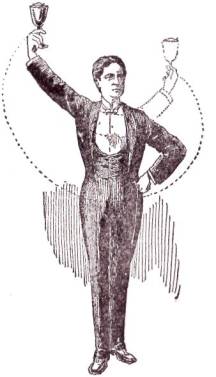
Fig. 8. Swinging the Floating Leaf
the pitcher, changing hands; then, holding the
goblet in the
other hand, fill it full as before, and extra
full also, to which
the rose leaf should be added.
With hands reversed as just stated, hold the
goblet out
in front of the chest half-arm's length. Rest.
Next hold it out full arm's length for a minute
in front of
the chest. Rest.
With the goblet full as stated and the leaf
floating on
top, pass it to the other hand, then back
again. In class
work we used to pass it from pupil to pupil until
some one spilled the water; then we would begin over again.
A very difficult task is to pass the goblet
from the hand to the table, then from the table to the floor and back again. A
stooping position tests the smoothness of the nerves as much as anything can
do.
The goblet is then raised to various heights
and positions.
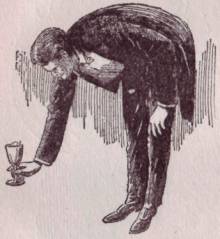
Fig. 9. Lowering
the Floating Leaf
When connected with much muscular effort, these
smooth-nerve tests do not always accumulate magnetism, although they tend that
way. When associated with tensing they never fail to develop magnetism rapidly.
When done with flabby life of the body, they are neutral, and have no value
except to teach control. When done with energy within the chest, they quickly
accumulate magnetic power. As we have said before, they are not all.
Other helpful tests are as follows:
1. Dressing. Put on a coat or jacket
without the loss of any motion small or great. The fidgety person will have
trouble
in finding the sleeve-hole,
or something will hitch.
Even the bullous must go into place with ease
and smoothness.
Wherever the coat may be in the room, lift it
from
its
place, put arms in the sleeves, and button it; all to be done
smoothly and easily.
2.
Shoes. Put
on your shoes that lace, inserting strings in eyelets, or catches, avoiding the
loss of any motion, howeversmall. When this is done, unlace
them. Do not use
force. Every movement must be smooth and free from hesitation.
3.
Books. Take a book from a table, open it at any page and turn ten
leaves forward. Close the book, place it on the table, and again take it up
with the other hand. Open it, turn ten pages forward; shut it; open again at
another place, and turn ten pages backward. No leaf must be missed, no motion
must be lost, and every detail must count some value. This is a very difficult thing to do
successfully.
As irritability destroys magnetism the purpose
of smoothness in the above exercises is double. There must be gentleness of
action and placidity of mind in every detail. That which would ordinarily cause
you to scold must be welcomed
as a test of your
perfect self-control.
END OF THE fourth step
|

