CHAPTER XIX DEAD-STILL TESTS
GAIN we extend the work and come into a different
line of practice. The preceding chapters make almost no demand upon your time;
here we present something that will; but it is proper to state that what is
sought here through mechanical exercises may be reached in the preceding
chapter by the forming of new habits. If you succeed in doing that, you may
omit most or all of this list of exercises, and depend upon the plan presented
in the chapter that has just closed. That plan is a new one in books, but we
have used it in private lessons for a long time, its great success leading us
to publish it. But the old method is also given, and will appear in this volume
in the present chapter, with fully three times as much new matter added as was
given in the preceding edition.
We may better call these exercises mechanical,
for that is exactly what they are; while those of the previous chapter are
natural. Being natural, they do not require separate time for practice. Between
the two series there is a middle class that is called semi-natural; and these
we will give first in the present chapter. More than twenty-five years ago the
author employed them in connection with his own development of magnetism,
supplemented by other work as presented in parts of this book; and he found
these semi-natural exercises the best of them all, as they prepared the way
for the natural practice.
These are now published for the first time.
SEMI-NATURAL TEST
FIRST MEETING: Go to some room where you will
not be in fear of interruption, and allow no person to enter
while you are practicing. This precaution is
necessary in all the meetings hereinafter.
"Alone with a
friend."
You are to admit a pretended person, and go
through all the details of conversation, you taking your own part aloud. Every
rule of the preceding chapter is to be observed here. We give an example of the
one-sided conversation with an imaginary friend.
Y. You go to the door,
open it, greet A. and show him to a seat. All the following remarks are made aloud by you:
"You are looking tired."
"No, I was not expecting you, but I had
been thinking of you and hoped you would come."
"Yes, I have been in all the
evening."
"Oh, no; not at all."
"Well, that's good; that's the best
yet."
And so on. It is not necessary for you to use
the above language; merely carry on a conversation with a supposed friend,
taking your side of the affair aloud. It is useless to sit and think of what
you are saying. Say it
right out.
SECOND MEETING.
"Accosting an
Acquaintance."
In your room you are to pretend that you are
walking along the street, by actually walking. You meet an acquaintance, stop
to shake hands and exchange a few remarks. The language is all yours.
"Well, well, who would have thought of
meeting you, andhere of all
places."
"You did? Yesterday?"
"'No, indeed; I have no time to spare. I'm
just crowded for time.
When do you go back?"
"I wish I could. I'll try to see you for a
few minutes, Good-bye."
Remember the principles of dead-stillness.
THIRD MEETING.
"A Headache."
A friend calls upon you and insists upon
talking voluminously, while your throbbing head causes you intense suffering.
You separate the sense of pain from consciousness as far as you're able. This
may be done by cultivating a magnetic will. No evidence of your own discomfort
must be shown the friend. The one-sided conversation is maintained by you
alone, and all is imaginary.
"Won't you be seated?"
"No, I did not care to go out this
evening. The weather is not as agreeable as I would like." Your head may
rest upon your hand, or you may take any easy position that you prefer,
avoiding the movements of an invalid, and making no lost motion.
"I did not get the book. I meant to do SO,
but I deferred the matter until it was too late."
"It must be very interesting."
"Yes."
"Certainly, I see."
"Yes, yes; it was unique, to say the
least. Very interesting."
"Not a bit. Go on."
"I presume it was a success."
And so on.
FOURTH MEETING.
"A Speech."
All orators have practiced alone. Those who
wish to win the favor of audiences must do their practicing and developing
before imaginary people. History is full of anecdotes in the lives of the
greatest orators, including many humorous and interesting episodes. The man
who thinks out his words and prepares himself in only a mental way, is as
little qualified to speak in public as the
pianist who touches thekeys for the first
time in the presence of his audience. Private practice has accomplished more
good in developing the orator, the conversationalist and the gentleman than any
other means.
So sure are we of this proposition, which we
have watched and tested for years, that we assert in most positive terms that
no orator can do well in public, except by years of bad effort, unless he has
addressed imaginary audiences in private. When a speaker of average ability
asserts that he never has done anything of the sort, but that he got his
experience in years of actual public work, we can reply that Daniel Webster,
Henry Clay, Patrick Henry, Gladstone, Beaconsfield, Beecher, Spurgeon and countless
others of fame and success were constant practicers before imaginary audiences.
In the cases of men such as Conkling, Blaine, Grady, Everett, Phillips, and
scores of others, the evidence of private practice before imaginary hearers has
come direct to the author.
Ladies and gentlemen who are trained to be
easy, graceful, polite and refined in society, are made to pass through this
same kind of practice. Imaginary meetings attended by real conversations on the
part of those who engage in the exercises, are the best, the quickest and the
most substantial means of acquiring the great results. It is better to go into
society, some one may say. Yes, that is true; but the experience gained in
real society costs many a sigh and often a heartache; and so why not aid it by
the kind of special training that does the most good?
One thing is certain—if you wish to develop
magnetism, you must be a grand master of dead-stillness. Every law and
principle set forth in this book must be used. Now it is very difficult to attain
anything like dead-stillness in the midst of the distractions of society. Lay a
good foundation outside, and carry the practice into the real opportunities of
life.
Use the voice aloud. Thinking is very good,
even when done silently; but the. mind can go galloping off in a dozen
directions and be pulled back again by as many
strings when you meditate or plan. The wandering moods destroy the keenness of
thought and weaken the mental processes. These are impossible if you speak
aloud, for then the brain must keep within the channels of a set direction; the
reasoning must be under control; the thoughts cannot drift, and speech becomes
more exact. Then there is a very important reason in addition to all these: the
reflex action of the sound of the voice upon the brain and nervous system
carries to brain and nerves the same value that the voice itself gives out; if
serious, thoughtful and earnest, the same qualities are stimulated; if light,
aimless and flippant, the results are equally faulty. Remember this.
In making a speech, stand up. Get to end of the
room and look upon a hall filled with people, all supposed to face you and to
eagerly listen to what you have to say. Commence with care and dignity. Be as
deliberate as if the people were really there, and do nothing that you would
not do in their presence. We cannot prepare practice speeches for you, as the
advantage comes from your own extemporizing. Think on your feet. Commit
nothing to memory; keep the hands at the sides unless you wish to give action
that will illustrate the meaning of your thoughts. We would suggest that you
speak upon one subject only at each meeting, and rest when you are tired.
Commence all over again as many times as you wish. Talk directly to the
audience, just as you would in fact.
Practice all the rules of dead-stillness as
given in the preceding chapter.
We now present a few introductions to your
imaginary audiences.
Let these be as refined and earnest as possible:
"Ladies and gentlemen: I have the honor to
present to you this evening the gentleman whom you are all anxious to hear, Mr.
Beriah Huston."
Then as the party introduced you come forward
apparently and say:
"I thank you, ladies and gentlemen, for
this hearty welcome.I have some misgivings as to whether I shall deserve it or not.
When I am through it may be seen that my kind friend has overshot the
mark in saying that you were anxious to hear me. It must be understood that these pleasant allusions
are formalities that prevail in public life and mean nothing in
particular. But, on
the other hand, I am anxious to address you and to spend a brief period in the
consideration of one of the most important themes of the day."
You are both introducer and introduced. Except
for the step or two which you take forward in the latter character, there is
no occasion for action of any kind. Dead-stillness is absolutely essential. We
now present another example.
"Ladies and gentlemen: We are assembled
here this evening to listen to one who has spent the greater part of his life
on the other side of the water. His public services and widespread fame render
him no stranger to us, and I am performing an almost superfluous act in
introducing to you Mr. Herbert D. Browning."
Then you advance and say:
"My friends,—I think I can call you
friends after this splendid reception,—I am highly gratified at this indication
that you are in accord with the views that I am about to express."
We advise the pantomime practice of social
introductions, of introducing others and of being presented. Nothing so
quickly refines the manners as this practice. It gives you a confidence and
smoothness in meeting people that no other plan will bring about.
But we must proceed to other things, and hasten
to take up the
MECHANICAL DEAD-STILL TESTS
While these are neither natural nor
semi-natural, as they
are apart from life, they certainly are
beneficial in the highest
degree if done correctly. We therefore call attention
to the
RULES FOR CONDUCTING
EXPERIMENTS
THEfollowing Rules apply only to the exercises and experiments of chapter
nineteen.
Rule 1.—Always
practice in a room or place where no other person is present, unless it is
somebody who owns a book, and is practicing with you. This latter arrangement
is better, as mutual aid and advice will hasten the progress and develop
better results. A class of pupils and fellow-students working together will
find the practice both pleasant and profitable.
Rule 2.—When any
fatigue or excessive irritation is apparent, stop and rest, closing the eyes;
then resume. The tired feeling will pass away after a few rests.
Rule 3.—Before
devoting, yourself exclusively to one experiment try all of them a few times.
If any can be performed satisfactorily, omit such in future experimenting.
Rule 4.—If there is
no likelihood of immediate progress in some of the more difficult experiments,
pass them for awhile and finish the mastery of the easier ones. Otherwise
follow the directions given.
Rule 5.—In order to
record success the pupil must either master all the experiments satisfactorily
or else devote thirty minutes daily, either consecutively or otherwise, to
these experiments exclusively, for four days in four weeks. Sixteen
consecutive days will not do. There should be a three days rest after four
consecutive days of practice.
Rule 6.—Any pupil who
fails to perform the experiments satisfactorily after a four weeks' drill must
carry along with his work, in subsequent stages, any unfinished experiments in
this.
Rule 7.—If the nerves
are sapped of their vitality by excesses of any kind, the overdoing of these
and subsequent exercises will produce a feeling of exhaustion.
In other words, it is advisable to keep in good
health; eat only the best of nutritious food; take care of the vitality
by proper regime, and allow no neglect of the
laws of hygiene to interfere with your progress here.
FIRST EXPERIMENT
Take a sheet of note paper, neither too stiff
nor too thin; tear it in halves; hold one-half of it in the hand by placing the
thumb and two fingers at the lower corner of the paper, holding the hand about
a foot from the chest, and the elbow away from the body. The entire arm must be
free—that is, must not touch anything, nor have any means of support.
If a mirror is convenient it is well to locate
some fine spot on the glass (if it has none, place an ink spot there), and hold
the paper so that the upper opposite corner from that in the hand shall be on
an exact line with the eye and the spot on the mirror. Hold this for twelve
seconds, and note the deviation of the corner of the paper from the spot. If
there is no deviation, you are ready to undertake the second experiment. If
there is, you should practice this until you can prevent any departure,
however slight, from the spot indicated; unless exempted by the Rules.
SECOND EXPERIMENT
Take a sheet of Congress paper, tear it in
halves and hold it in the same manner as in the first exercise. Persist in
practicing until there is no deviation even of a hair's breadth. Do not be
discouraged if it requires patience. The left hand may be employed about
one-quarter of the time, or vice versa, if the pupil is left-handed. It
may be necessary to resort to Regime for aid in hard cases.
THIRD EXPERIMENT
When the last exercise has been mastered the
pupil may takea sheet of the
larger size foolscap paper, tear it in halves, and continue as before.
FOURTH
EXPERIMENT
When the third exercise has been accomplished
the pupil may take an entire sheet of foolscap paper, and, without tearing it,
open the whole sheet and hold it by the lower corner, having the thumb and two
fingers upon as small a portion of it as possible. The paper must be just stiff
enough to stand alone. Making a hollow curve diagonally across the centre will
aid in keeping it stiff.
Be sure that the elbow has no support and is
extended from the body.
FIFTH EXPERIMENT
Fill a goblet two-thirds full of water; take it
at the small part just above the bottom, by the thumb and first finger only,
and hold it for thirty seconds on a level with the chin, the elbow being away
from the body and the whole arm free. The water must not shake or even
tremble. Rest.
Hold it in the same way, employing the thumb
and second finger only, for thirty seconds. Rest.
Hold it in the same way, employing the thumb
and third finger only, for thirty seconds. Rest.
Hold it in the same way, employing the thumb
and little finger only, for thirty seconds. Rest.
Your patience will be sorely tried.
These experiments will seem to make you
"nervous;" you will say that instead of making you control yourself
better; they irritate and vex your nerves. So it will seem at first, and
likewise at all times when your leakage is going on rapidly. This apparent
"nervousness" is really the rebellious leakage being checked. It
dislikes to be stopped. A "nervous" person wants to let the leakage
go on until complete prostration ensues. There is a temporary agony in the
checking of the outflow of this vital force. While the loss is going on the
person walks and moves about, swings the feet or twitches the hands, tears
paper, fingers some button or watch
chain, gets in a rocking-chair sometimes, and shows every manner of
restlessness. The down
hill grade has begun.
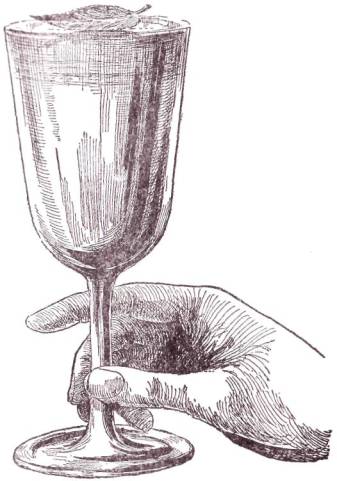
Fig. 4.
Floating the Rose-Leaf.
To check it at first is to make the person suffer. Yet the great men and
women of the world have somehow learned to stop this waste. Those who want to
achieve greatness, or even wish to learn to control others, must endure the
suffering.
In conversation with those who have been
magnetic and have been successful in life, it was learned that every one had
made some effort to check this waste of vital force. Not
one knew the principle involved, and not one
had the advantage of any guide or help; and stranger yet, none knew that any
other person was endeavoring to reach the same result. Such conversations
proved that our great men and women do more for themselves in private than the
public suppose. Some of their efforts are often simple, child-like, and even
ridiculous. Yet they accomplish great ends.
You who give up now would better cease to hope
for much in this world in the way of commanding talents.
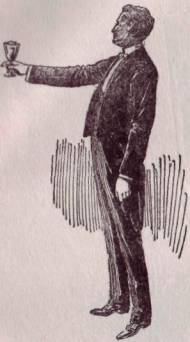
Fig. 5. Extending
the Floating
Leaf
SIXTH EXPERIMENT
Take a goblet (not a tumbler) even full at the
top with water. Place the bottom in the flat palm of the hand and hold the same
at arm's length. The water must not be allowed to spill or even shake or
tremble. The other hand may be tried occasionally. Then procure the aid of a
friend who is to give you two goblets of water, one in each hand, the water coming
to the top and slightly rising above the edge. Hold these in the two hands out
at arm's length for thirty seconds, without the slightest tremor or shake of
the water. You will not be able to do this at first, but perform it
daily for month, and you will
be surprised at the result If
yougive it up before the full design is effected you will yet
learn
what patience is, and patience helps to overcome the erratic action of the vital-force.
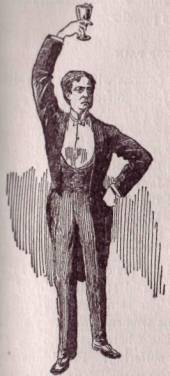
Fig. 6. Raising
the Floating
Leaf,
The fact that the water trembles or overflows
at the top need not discourage you. "We are constantly receiving reports
from our members who have failed utterly and have given up all hope of accomplishing
anything in this practice.
One says:
"The water shakes out and spills. I can no
more do that exercise than I can jump over the moon." And we reply,
"Oh, yes, you can. The very fact that you cannot do it is proof of the
need you have of it"
No one need fail ultimately. All can do it in
time. Those who have given up completely have in most instances, come back to
the practice drawn by the fascination of it and they have succeeded in the most
difficult of all experiments, the great Rose Leaf Test, which is now for the
first time made public, although we have given it many times to our private
pupils. It will be
presented in the next chapter.
The goblet experiments have great value in
bringing the
nerves to absolute perfection. They are tests that never
tell
anuntruth. The
nerves may be alive, jumping, irregular,
erratic and out of normal health, while it is
possible for a person of strong will to keep all the muscles dead-still. So we
see that the present experiments reach a
condition that may always escape the previous exercises. They give smoothness
to the flow of the nerve-currents; they tone down the irritated fiber; they do
for the direct electric system of the body what dead-still practice will do for
the muscles. Experience alone can show the great benefits of this practice.
THEY OFTEN STOP PAIN"
You can easily see why some persons will have
neuralgia under conditions that should give freedom from all such pain; but the
distracted beating, throbbing pulsations of the nerves, vibrating in discords,
keep the soreness there. Toothache has often resulted from the same erratic
action of the nerves, there being some sensitiveness in the tooth, but not
enough to account for the steady ache. Many and many a time has an hour's sleep
in the middle of the day or early evening, driven away a severe toothache. Why?
Because the nervous system has been quieted by the sleep. The tooth has not
been repaired.
On exactly the same principle will the
experiments of this series of exercises quiet the nerves and still the pain of
an aching tooth and of neuralgia. The same test has proven true in cases of
pregnancy. Some women suffer very much from neuralgia and from toothache where
the teeth are all in good condition. Why is this suffering? Physicians say it
is due to pressure upon some great nerve. The fact is it is due to the new life
within the body, the excitement of the whole nervous system causing that
throbbing of special nerves, at first reaching the stomach and later on the
upper parts of the body.
These experiments have removed such pains.
Magnetism will cure any ache that is due to the abnormal pulsing or beating of
the nerves, for it brings the life-currents into smooth movements and stills
all excitement. That body is in most perfect health when this smoothness of the
nerves is attained.
DENTISTS
Many of our pupils have been dentists. They of all
persons
require
not only muscular dead-stillness, but nervous
dead-stillness, and these experiments have so
qualified them
for exactness of movement
and delicacy of touch that their
skillas well as their income
have been greatly increased.
Thesensitive spot on a tooth is often very small; a careless
oruncontrolled movement of the hand would cause severe
painto the patient.
The dentist who allowed a drill to slip
andpenetrate the flesh of the cheek, coming through on the
outside of the face, would never have had the
accident had
he been a student of magnetism and his patron would
not
nowbe disfigured for life. The person of steady nerve will,
if the instrument
slips, not allow it to pass an eighth of an
inch in any direction.
SEVENTH EXPERIMENT
Hold the arm free from the body and wholly
unsupported, and very slowly and smoothly cause the thumb and forefinger to
approach each other, touching as lightly as possible, without pressure. Both
thumb and finger should meet half way. Repeat this with each of the other
fingers and the thumb.
NINTH EXPERIMENT
Hold the arm out at full length, in front, the
hand on
a height with the
eye. Form an index
hand, the back facing
upward, the point of the first finger on a line
with the eye
andsome spot on the wall.
Hold this forty-five seconds
without allowing the point of the finger to
move a hair's
breadth.
TENTH EXPERIMENT
Approach some object (a table or desk is
sufficient), and gently lay the points of the fingers upon it, commencing with
the little finger, then the others in turn, and finally the thumb. This must be done slowly
and without jerks.
ELEVENTH EXPERIMENT
While in a large room try to follow with the
steady eye a line on a height with the head, or if there is no line, then an
imaginary one, first from left to right, and reverse. Do this slowly fifty
times each way. The eye must not move by small muscular jerks, but very
smoothly and slowly. It is not easy to do, and to do well. Do not wink while doing it.
If outdoors, try it by following a horizontal
line of mortar on a brick building, or the clap-board of a wooden one.
To those to whom the object of the foregoing
experiments may not seem clear, it will be necessary to say a word:
The pupil is asked to remember that the vital-force
is the life of the body; from it is generated the Magnetism which controls
others. It is constantly being formed, and some portion of it is constantly in
motion. It propels the action of the involuntary organs by the decree of its
Maker, and without the direction of the human will. The heart circulates the
blood; the diaphragm attends to the breathing; and the stomach propels itself
during digestion; and thus the trinity of life's movements, without each and
all of which life itself would cease, may be traced to the action of the vital-force,
and through that to some power beyond.
But here the line is drawn, and one of the
Principles of Personal Magnetism is called into requisition:
"No movement of any voluntary muscle of
the human body must be made unless directed by the will."
The voluntary muscles are those whose motions
may be operated by the conscious being.
As had been stated heretofore, nervousness is
a leakage of the Magnetic-force unpropelled by Internal Energy.
How much takes place may be seen in the
foregoing experiments. Any trembling of the paper held in the hand, or any
deviation of the chalk from the straight or curved lines is caused by the
erratic action of the above-named
forces,
or, in
other words, it shows a leakage of the Magnetic Power; for, as we move the hand in one instance, so we move
thewhole body in others. Leakage
occurs in the following ways:
1.
By unsteadiness of the hands, arms or body.
2. Twitching of the
eyelids, or constant winking.
3. Drumming with the fingers
after the habit has been formed, or with the feet.
4.
Sighing.
5.
Gaping.
6.
Wakefulness.
7.
Swinging of the arms, hands, legs, feet, head or body.
8.
Rocking, after the habit has been formed.
9.
Restlessness.
10. Twitching of the fingers, or any movement
of any part of the body during embarrassment, or while speaking or being spoken
to.
11.
All kinds of embarrassment.
12.
Awkwardness.
13.
Shorter exhalations (in point of time) than inhalations. 14. Stammering and stuttering.
15.
Lack of fluency in speech where it cannot be attributed to want of words
or ideas.
16.
Allowing the ankle to be turned or a strain to be put upon any muscle by
an uneasy standing position. Never have the
foot
on its side. Never
twist the body.
Who are exempt from all these ?
The cool, determined, successful, magnetic
people of the world.
|

